
The bill to nullify retrospective taxation offers a fair solution within the framework of Indian law and Parliamentary sovereignty to companies which have been subjected to such demands, Finance Secretary T V Somanathan said on Thursday. Finance Minister Nirmala Sitharaman introduced 'The Taxation Laws (Amendment) Bill, 2021' in the Lok Sabha that seeks to withdraw tax demands made using a 2012 retrospective legislation to tax the indirect transfer of Indian assets. The Bill provides for the withdrawal of tax demand made on "indirect transfer of Indian assets if the transaction was undertaken before May 28, 2012 (i.e. the day the retrospective tax legislation came into being)."

Annapoorna chain of restaurants owner Srinivasan is seen purportedly highlighting concerns over varying GST rates. In the second video, Srinivasan was seen purportedly apologising in person to the Finance Minister.

With the reality of coalition politics staring the BJP in its face, this was inevitable, points out Ramesh Menon.

Few finance ministers announce any taxation measure that could upset the stock market. Ms Sitharaman decided to take that risk, observes A K Bhattacharya.


There is a need to incentivise R&D investments, offer corporate tax concessions and establish an effective intellectual property rights regime in order to push the growth of domestic pharmaceutical industry, as per the industry bodies. Outlining the sector's wish list for the upcoming Union Budget, Organisation of Pharmaceutical Producers of India (OPPI) Director General Anil Matai urged the government to explore methods to incentivise R&D investments, such as deductions on R&D expenses, research-linked incentives for MNCs, and corporate tax concessions.

The gross tax revenues have touched 65 per cent of the Budget estimates at Rs 17.81 lakh crore during the first eight months of the current fiscal till November, propelled by corporate and personal income tax mop-up, according to the Economic Survey 2022-23 presented in Parliament on Tuesday. The survey, authored by Chief Economic Advisor V Anantha Nageswaran, said the 'substantial reforms' in India's taxation ecosystem post-2014 and policy reforms have removed the distortionary incentives from the economy. Reforms like GST, reduction in corporate taxes, exemption of sovereign wealth funds and pension funds from taxes, and removing Dividend Distribution tax have reduced the tax burden on individuals and businesses.

The generation of quality jobs and skill development should be the focal point, cutting across ministries and departments, asserts Nivedita Mookerji.
Investments of up to Rs 100,000 in tax-saving funds are eligible for deduction under Section 80C of the Income Tax Act. This has opened up a new spectrum for investors while conducting their annual tax-planning exercise.
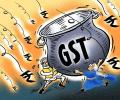
GST collections rose 12 per cent to over Rs 1.61 lakh crore in June, the finance ministry said on Saturday. The gross GST collection has crossed Rs 1.60 lakh crore mark for the fourth time since the roll-out of the indirect tax regime six years ago on July 1, 2017. The average monthly gross GST collection for the first (April-June) quarter of the 2021-22, 2022-23 and 2023-24 are Rs 1.10 lakh crore, Rs 1.51 lakh crore and Rs 1.69 lakh crore, respectively, the finance ministry said in a statement.

Cars and two-wheelers attract 28% GST and a cess in the range of 3-22%, taking the effective tax rate to up to 50%.

The one national GST unifies the country's $2 trillion economy and 1.3 billion people into a common market, an exercise that took 17 tumultuous years.

Eminent economist Arvind Panagariya has said India is on the cusp of returning to a high growth trajectory and voiced confidence that the country will become the world's third-largest economy by 2027-28. Currently, India is the fifth largest economy "so it's another five years.We are already in (the year) 2023. "So 2027-28, India should be the third-largest economy," Panagariya, Columbia University Professor and former Vice Chairman of NITI Aayog, told PTI in an interview in New York.

Companies in China, South Korea and Indonesia pay 25 per cent tax, while those in Malaysia pay 24 per cent. Only Japan has a higher tax than India at 30.6 per cent. Hong Kong has the lowest corporate tax rate of 16.5 per cent while Singapore has 17 per cent rate and Thailand and Vietnam levy 20 per cent tax on companies.

GST would make compliance easier for big businesses, but hurt small scale industries., says SJM

The Income-Tax (I-T) Department nowadays provides pre-filled forms to make the filing of income-tax return (ITR) easier. Nonetheless, you must have a number of documents handy at the time of filing return so that you can cross-check the data in the pre-filled form. "Filing ITR doesn't require you to upload any document. But in case an assessing officer makes an inquiry, you will need to present documents and certificates as proof," says Deepak Jain, chief executive, TaxManager.in.

Taxing the rich will fetch nothing; only votes, argues Debashis Basu.

The Budget proposal will help startups with better incubation, talent and capital

What stood out in his 15-year journey as a member of the political executive at the Centre was his glowing record as India's most successful and effective finance minister. Both as prime minister and finance minister, he understood the importance of gradualism, except when the economy or the polity was in a crisis.

The Union Cabinet on Wednesday approved changes to GST laws to levy a 28 per cent tax on the full face value of bets in online gaming, casinos and horse race clubs, sources said. The amendments to the Central GST (CGST) and Integrated GST (IGST) acts, which were approved by the GST Council last week, are likely to be introduced in the ongoing monsoon session of Parliament, which will end on August 11. The GST Council in its 51st meeting on August 2 recommended amendments to the Schedule III of the CGST Act, 2017, to provide clarity on the taxation of supplies in casinos, horse racing and online gaming.

Insurance companies may soon face goods and services tax (GST) audits as tax authorities plan a "deep dive" into their business practices to check for the possibility of a raft of tax-linked irregularities. Several insurance companies are being probed for wrongly availing of the input tax credit without the underlying supply of goods and services based on fake invoices generated by their channel partners and intermediaries. "We want to deep dive into the overall business and see if there are further taxation issues besides commissions, which are already being investigated," a senior official of the Central Board of Indirect Taxes and Customs said.
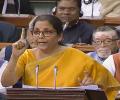
'The economy needed 3 or 4 major fixes. The major one was, of course, the direct tax structure, but we ended up complicating the existing convoluted tax structure,' says M R Venkatesh, chartered accountant and lawyer.

'TMFs trump FMPs and FDs when it comes to investing in a high-duration product.'
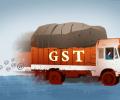
Of the two rate structures on the table, one suggests tax slabs of 8 per cent, 16 per cent, and 24 per cent. The other proposes tax slabs at 9 per cent, 18 per cent, and 27 per cent.

Anamika Pareek explains the advantages of investing in tax-saving options like the equity-linked savings schemes.

A taxpayer paying rent to his/her spouse is entitled to claim HRA benefit under relevant sections and within prescribed limits.

About a dozen states cutting across party lines on Wednesday pitched for extending the mechanism to compensate states for revenue lost from the implementation of GST beyond June 30, but no decision was taken. Briefing reporters about deliberations at the two-day meeting of the GST Council in Chandigarh, Union Finance Minister Nirmala Sitharaman said finance and other ministers of 16 states spoke on the compensation issue. Of the 16 states, 3-4 spoke of evolving their own revenue stream to break from the compensation mechanism, she said.
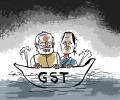
Agra has long been known for the Taj Mahal, but it is also a manufacturing hub filled with micro, small and medium enterprises (MSMEs) that make everything from electronic components to metal products, from paints and chemicals to footwear. And five years after the introduction of the Goods and Services Tax (GST), the MSMEs here complain that while the indirect tax regime has been transformative, cutting out the need to file multiple taxes, its biggest drawback has been the delay in credit refunds. Whoever you speak to - MSME owners, tax lawyers, or industry bodies like the National Chambers of Industries and Commerce (NCIC), Agra Footwear Manufacturers and Exporters Chamber (AFMEC) and Agra Shoe Manufacturers Association (ASMA) - they all emphasise that the GST continues to face some key challenges.

The government said that far from targeting any US entity, the purpose was to ensure fairness, healthy competition, and to exercise the ability of governments to tax businesses having a nexus with the Indian market through digital operations.

Capital gains exemption limit and a steep reduction in the highest surcharge will empower the masses with enhanced liquidity flow that can be invested in real estate, points out Dhaval Ajmera.

Union Finance Minister Nirmala Sitharaman, along with her team of bureaucrats, delved into the fine print of the 2024-25 Budget documents in a press conference, detailing the government's road map on bringing down the debt-to-GDP ratio and bold tax measures.

The cryptocurrency exchanges in India have got a fresh lease of life following the bull run in Bitcoin, which briefly hit a new all-time high of more than $69,000. Siddharth Sogani, managing director of CREBACO, expects the price to cross $1,00,000 by the end of the year. This will see a sharp reversal in the Indian market, which has largely been dormant since the new tax regime was implemented in 2023.

Crypto exchanges have been asked to furnish details this month itself.
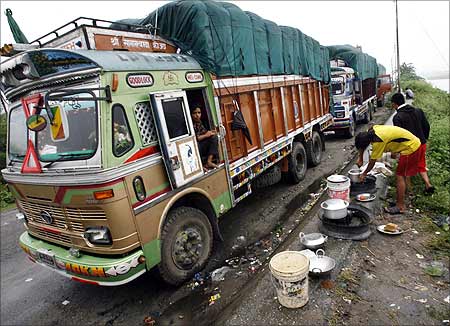
There could be a strong incentive for tax payers to avoid the higher tax burden.

The finance minister clarified that indexation benefits offered until April 1, 2001 would be protected. This means older properties, including legacy assets, would benefit.

Indian charitable trusts, including Tata Trusts and top corporate donors, are stumped by a new tax law proposed in the Budget, which reduces tax breaks for the donor organisations. The Finance Bill proposes that if a charitable organisation donates to another charity, then only 85 per cent of the donation will be considered as application of income for the donor organisation. Trust officials say this is a major setback for the donor organisations, including corporate foundations and intermediary organisations, which work with various implementing agencies at the grassroots level.

Across 10 prominent services, revenue to the government reduced by 20 per cent in the first year of GST compared to the last year of the service tax regime. This happened despite tax liability against these services growing by 50 per cent in one year.
 © 2026 Rediff.com - Advertise with us - Disclaimer - Privacy Policy - Sitemap - Feedback - About us - Terms of use - Grievances